
Support quality, independent, local journalism…that matters
From just £1 a month you can help fund our work – and use our website without adverts. Become a member today

Social media has “become a breeding ground for harm, bullying, addiction and anxiety”, Senedd Members heard as they debated banning it for under-16s.
South Wales East MS Natasha Asghar, the Conservative shadow education secretary, led calls for a ban, saying social media is “putting our children at unnecessary risk”.
A social media ban for under-16s has recently been introduced in Australia, while Spain and France have plans to do the same.
Ms Asghar’s motion, which called on the UK Government to restrict access to social media for under-16s, was rejected by Senedd Members. However, an amended version of the motion, submitted by the Welsh Government, was approved.
That amendment fell short of calling for a ban, but committed the Welsh Government to work with the UK Government on the issue, and welcomed an upcoming UK consultation on the matter.
It also called for social media companies to be held responsible for harmful content on their sites, while also calling for a “diverse range of children and young people” to be involved in the ongoing debate.
‘A proper childhood’
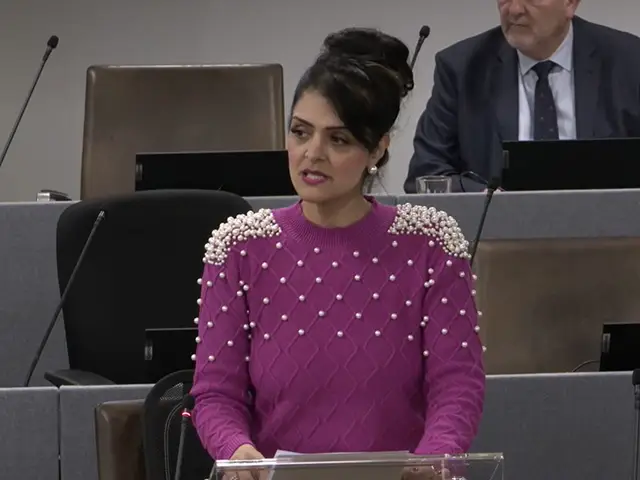
During the Senedd debate on Wednesday February 11, Ms Asghar highlighted the “hugely negative impact” social media has on children’s education and said: “Australia introduced restrictions on social media for under-16s late last year, and already they’re seeing benefits.
“Whilst the full impact is yet to be known for a while, early indications suggest that they are seeing reduced screen time, lower exposure to cyberbullying, and that it has created an environment for children to thrive at school and really spend more genuine time with their loved ones.”
She added: “Polling shows that the vast majority of both children and parents support an age limit for social media use. According to More in Common, 77% of parents support this, and data from YouGov shows that 83% of generation Z-aged people in the UK are in favour of this too.”
Meanwhile, her party colleague Sam Rowlands described a ban as “common sense” and said: “We cannot expect parents to single-handedly protect their children from these highly addictive digital environments.
“It’s about giving parents the tools they need. It’s about setting clear standards for what is safe and appropriate in our society.”
Tory MS Peter Fox said the debate was “not an anti-technology argument” but about “recognising that social media platforms are not designed with children in mind”.
The grandfather-of-nine continued: “Our kids and grandkids may be skilled with technology, but they are not emotionally equipped, even in their early teens, to deal with the pressures these platforms create.”
‘Cost to the NHS’

Labour’s John Griffiths said children’s social media use is a “cost to the NHS in terms of rising obesity, short-sightedness, anxiety, depression, sleep problems, and shorter attention spans”.
He also highlighted “the cost to schools in managing poor behaviour” and said: “Teachers report worsening behaviour and concentration, fuelled by the fast-paced environment of digital content.”
Mr Griffiths, who has represented Newport East since 1999, explained how social media use impacts boys and girls differently: “A consistent finding in studies is that it is particularly harmful for young girls’ happiness with their physical appearance.”
He pointed to the Netflix drama Adolescence and said: “For young boys, there’s a danger of becoming immersed in an online world that has allowed the rise of online misogyny and radicalisation.”
Carolyn Thomas, a fellow Labour MS, said: “Studies show that one in four people is using smartphones in an addictive way and losing grey matter, similar to someone with substance abuse.”
‘Extreme content’
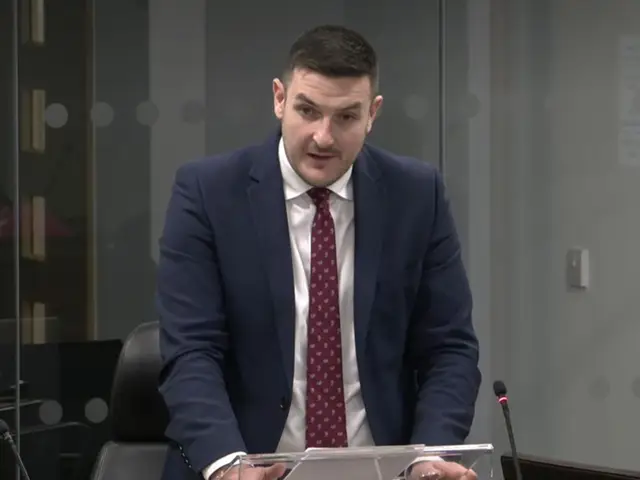
James Evans, who this month joined Reform after leaving the Welsh Conservatives, said the UK should be “seriously looking” at Australia’s ban.
“Children are being exposed to extreme content, including self-harm, eating disorders, pornography and violence, often within minutes of signing up, not because they ever searched for it, but it’s because of how the algorithms push it at them.”
He said parents couldn’t “compete with billion-pound tech companies” and continued: “We already have age limits and they’re ignored; we already have guidance and it’s unenforced; and we already have promises from tech companies and they have been broken.”
‘Easy headlines’
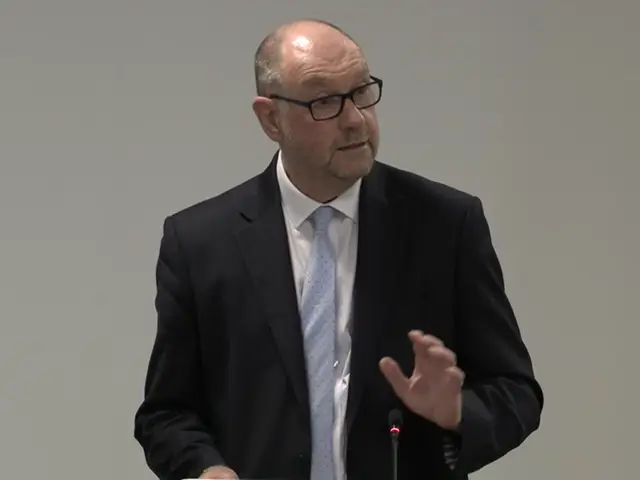
Plaid Cymru’s Cefin Campbell agreed something had to be done to address the concerns raised, but urged any action should be based on evidence.
“It’s very easy to rush to find solutions or to make easy headlines,” Mr Campbell said. “But what we have to do is take our time and see what the impact is of any policies being implemented in Australia, for example, to see what good things and not so good things emanate from that work.”
Independent MS Rhys ab Owen warned that limitations in technology, such as the effectiveness of facial IDs, “have allowed children in Australia as young as 13 to pass as 18-year-olds to use apps such as Snapchat and Meta Facebook.”
He added: “UNICEF has reported that these age restrictions alone won’t keep children safe online.”
‘One of the biggest issues of our time’
Welsh Government education secretary Lynne Neagle said evidence needed to be gathered to “shape an approach that puts the needs and protections of young people first” and urged against “simplistic solutions”.
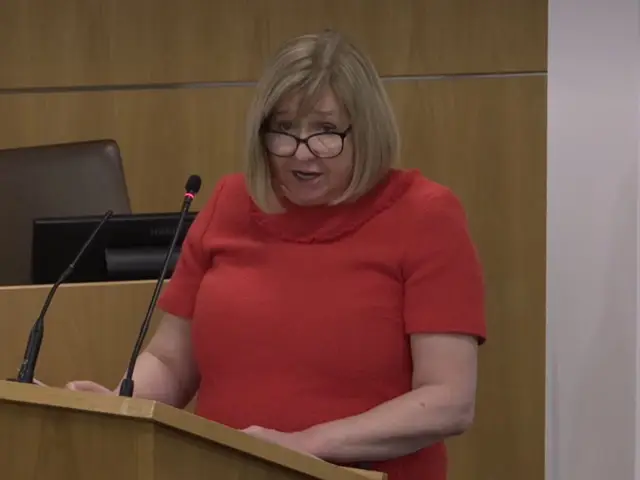
Ms Neagle said “we are grappling with one of the biggest issues of our time” and continued: “Everyone agrees that young people deserve safer social media experiences, but how to deliver this remains a live debate. Decisions that are made will shape our young people’s lives.
“Amid the intense media focus and public debate, we must be confident that the approach taken is the right one, and that it is shaped by solid evidence.”
She added: “As the consultation gets under way, it is vital that Welsh voices, particularly those of our children and young people, are heard clearly.”
However, Ms Asghar told the education secretary: “You’d rather kick everything into the long grass and get bogged down in consultations, which is not the way I see things”.
Ms Asghar urged: “We simply haven’t got the time. We need to act now.”
But Plaid Cymru’s Mabon ap Gwynfor questioned the definition of social media in the Conservative motion, pointing to encrypted messaging apps like WhatsApp and Wizz – where “grooming and sexual exploitation happens at a large scale”.
Backing the Welsh Government amendment, Mr ap Gwynfor said an “evidence-based policy” is needed.
The Conservative motion was rejected 25-12, with 14 abstentions. The Welsh Government amendment was backed 38-11, with two abstentions.
Support quality, independent, local journalism…that matters
From just £1 a month you can help fund our work – and use our website without adverts.
Become a member today