
Support quality, independent, local journalism…that matters
From just £1 a month you can help fund our work – and use our website without adverts. Become a member today

Today, voters in Wales will go to the polls to decide the future direction of our country for the next four years.
Democracy is not a perfect system. By its very definition, it is a populist mechanism often characterised by short-term goals and promises so that politicians and parties can get to the end of the term and hopefully prove their popularity once again.
It can be divisive and polarising – especially where there seems to be little common ground between those on the traditional ‘left-right’ axis.
Many people will not be voting today – and I understand the reasons why.
My late father always used to say: “It doesn’t matter who’s at the top, it’s the same at the bottom” – albeit in more colourful language.
Senedd elections have notoriously poor historic turnouts. The Caerphilly by-election in October last year was notable for the fact that turnout hit 50%. But, more than a quarter of a century on from devolution, it shouldn’t be this way.
The Senedd, and prior to that the Assembly, is no longer just a ‘talking shop’ that can tinker with rules around the edges – it has some serious power.
The NHS, education, transport, tax, planning, housing, waste – real stuff that impacts people’s lives on a day-to-day basis.
Yet understanding of the Senedd, and the Welsh Government, can still be confusing as ever.
Over the past few weeks we’ve tried our best to explain what you are voting for in a straightforward way.
We’ve outlined how the new voting system works, the thinking behind why Wales is getting more Senedd Members, and the differing positions of those standing.
This is the first election where full proportional representation will be used to determine who takes power.
One of the criticisms of the first-post-the-post system – still used in UK Parliament elections – is that votes in ‘safe seats’ are wasted.
This is no longer the case in Wales with each constituency returning six members. If you vote for a party, or an individual, they have a chance of getting elected – there are no wasted votes.
This is your chance to have your say and set the direction of Wales until 2030.
Good luck.
PS. Unlike UK Parliament elections, you don’t need to bring ID with you to polling stations, which close tonight at 10pm.
Verification of the votes, which tally how many have been cast, will be happening tonight with the count proper to decide Senedd Members taking place throughout tomorrow.
A new voting system and more Senedd Members
If recent opinion polls are to be believed, the election could be one of the most consequential since the Welsh Parliament – then known as the Welsh Assembly – was established in 1999.
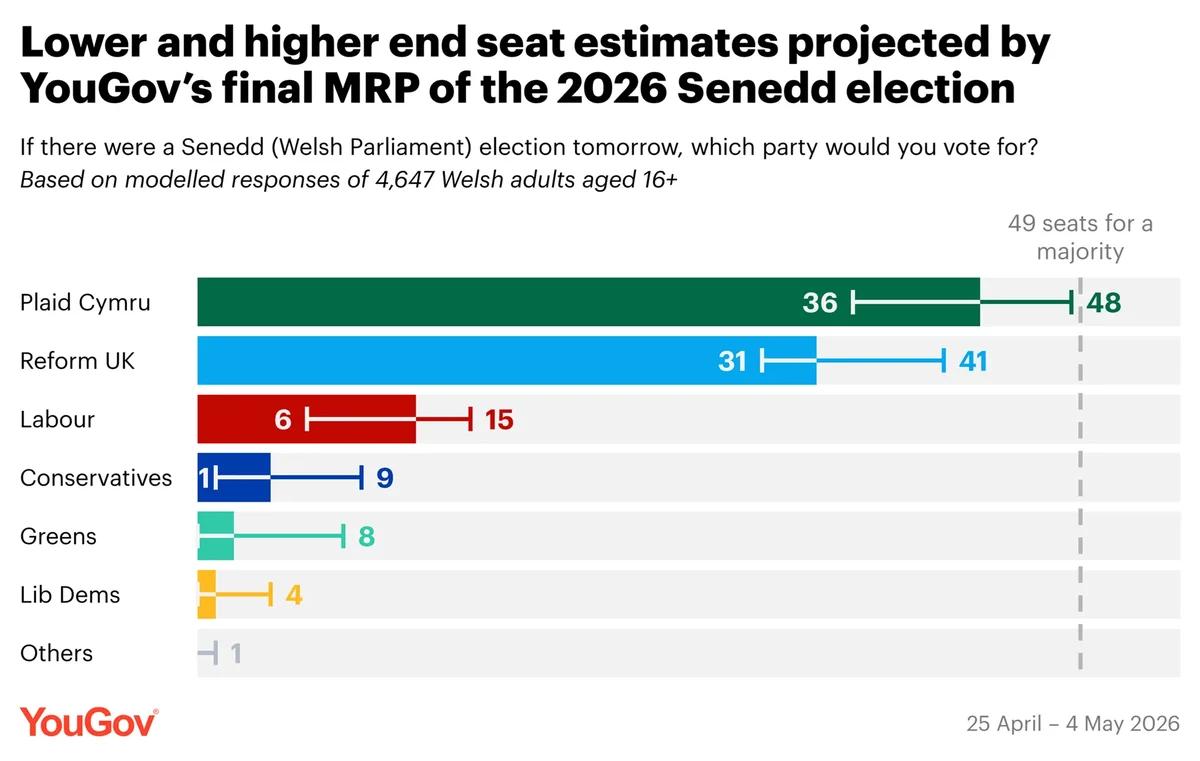
Plaid Cymru is currently on course to take the most Senedd seats, but fall short of an overall majority – with Reform UK the second-largest party.
But from new constituencies and more elected members, to changes in how votes are counted, there’s a lot to get your head around.
What the new voting system is and why they’ll be more Senedd Members
Welsh-only: The new constituency names for the 2026 Senedd election
Devolved versus reserved powers: What does the Senedd actually control?
Senedd Cymru, or the Welsh Parliament, is the devolved, democratically-elected, law-making body for Wales responsible for large swathes of public life.
While Wales is responsible for areas such as education and healthcare, matters including immigration, justice and policing, and defence remain under the control of Westminster.
What the parties are promising
What are the main political parties promising voters? Our Senedd reporter Ella Groves, whose position is paid-for via Welsh Government grant funding, has been wading through the manifestos looking at what each party is offering voters.
2026 Senedd Election: What are the parties saying about taxation?
What are the major parties saying about education and childcare?
What are the major parties saying about human rights, social justice, and equality?
Healthcare: What are the main parties saying in their manifestos?
Who are the candidates?
Party candidate lists for Blaenau Gwent Caerffili Rhymni
Party candidate lists for Casnewydd Islwyn
Support quality, independent, local journalism…that matters
From just £1 a month you can help fund our work – and use our website without adverts.
Become a member today