
Support quality, independent, local journalism…that matters
From just £1 a month you can help fund our work – and use our website without adverts. Become a member today
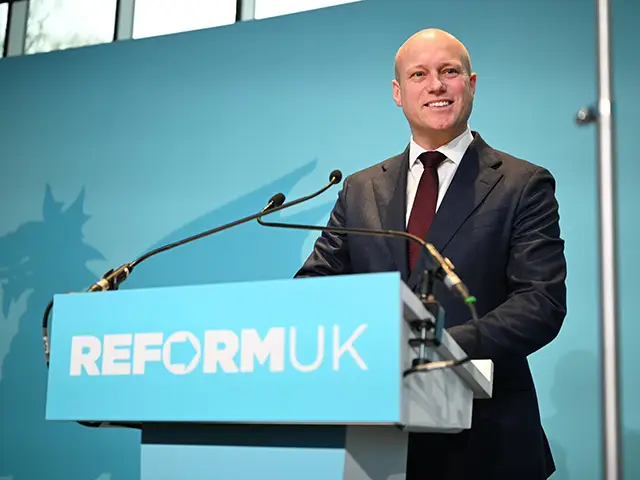
It’s the party making all the noise in UK politics at the moment, and if the pollsters are right, Reform is about to firmly mark its territory in Welsh politics.
Nigel Farage’s party, led in Wales by Dan Thomas – a former Conservative council leader in London – made its presence known in the Caerphilly by-election.
Now, polls are putting it neck and neck with Plaid Cymru – but if Reform is the largest party after the election, will it have enough support from other parties to form a government? Or will the anti-Reform vote lock Mr Thomas and co out of power?
The party’s manifesto sets out five core pledges. These are: to cut taxes and put money back in the pockets of Welsh people; to scrap blanket 20mph limits; to put Welsh people first; to build Wales for the future; and to back Welsh farmers.
Lower taxes
One of the headline pledges of Reform’s manifesto is to cut 1p off every pound on all bands of Welsh income tax “to put more money into your pocket”, with the party specifying the policy will be implemented “by the end of our term”.
Senedd terms are currently fixed at five years but following the 2026 election, this will switch to a four year cycle – meaning the next election will take place in 2030.
Reform says this cut to income tax will be delivered through reductions in expenditure elsewhere – but crucially without cuts to frontline services.
However what reductions will be made instead are not specified.
Reform also pledges to introduce a tax lock, stating it will not introduce any new Welsh controlled tax or levy that is not set out in its manifesto and approved by voters.
Scrap 20mph limits
Promising to “restore sanity” to Welsh roads, the second core pledge in Reform’s manifesto is to scrap blanket 20mph limits – something also proposed by the Welsh Conservatives.
Reform says that speed limits will be at the discretion of local authorities “where they are genuinely needed” such as outside schools, hospitals, and in clearly defined residential areas.
It has called for “evidence-led limits that improve safety without strangling town centres or turning the daily commute into a daily irritation”.
Opponents to the 20mph speed limits in Wales often cite a paper published in the Journal of Epidemiology and Community Health, which found ‘restricting speed limits to 20mph in town and city centres doesn’t seem to reduce road traffic collisions, casualties, or driver speed’ – but these results have been widely misrepresented.
Walk Wheel Cycle Trust highlighted the study focused on the results of a small-scale 20mph speed limit implementation across 70 streets in Belfast.
The average speed before the implementation was 17mph – meaning the new speed limits made little difference to vehicle speeds in the area.
The Belfast study was part of a two-site research with Edinburgh, where 20mph limits were implemented city-wide.
In Edinburgh researchers found significant positive results for collisions, casualties and speed and recommended 20mph speed limits were implemented citywide.
Data, published in June 2024 by the Welsh Government on police recorded road collisions, also showed reduced casualties on 20/30mph roads since the implementation of the 20mph limits.
“Put Welsh People First”
Repeated throughout the manifesto, Reform UK promises to “put Welsh people first.”
The party vows to end the ‘Nation of Sanctuary’, claiming it has “handed taxpayer-funded support to illegal economic migrants and welcomed unvetted military-aged men into our communities.”
Reform describes the policy as a “clear security risk” and an “ever-growing burden on the Welsh taxpayer”.
Introduced in 2019, the ‘Nation of Sanctuary’ sets out how the Welsh Government can support refugees and asylum seekers in Wales – and has predominantly been used to help Ukrainians escaping from Putin’s war.
It includes, but is not limited to: making sure refugees can find new accommodation when they leave asylum accommodation; helping refugee or asylum seeker survivors of domestic abuse get support; supporting child asylum seekers to get the advice and support they need; and promoting an understanding of Welsh culture and heritage amongst asylum seekers.
Importantly, immigration policy is a reserved power – meaning it is in the hands of the UK Government and is not devolved to Wales. The Senedd and the Welsh Government have no power to contravene UK immigration law.
“Build Wales for the future”
Describing a “lack of investment for decades”, Reform pledges to “build Wales for the future” by investing in infrastructure and development.
The party says it will build the M4 relief road, upgrade the A55 North Wales expressway, and fast track A470 upgrades.
It also promises the launch of a “modern industrial strategy” to create jobs and unlock investment.
Part of this modern strategy appears to be the “protection of strategic national industries”, particularly steelmaking.
Reform claims that as the next Welsh Government, it would work with Westminster to protect national industries such as steel.
A Reform government would also see the appointment of a minister for industry, who will “advocate for investment in key sectors to create the jobs of the future including in energy, AI and data centres”.
Positions described in the manifesto as “tokenistic ministerial responsibilities”, such as the minister for climate change, would be abolished under a Reform Welsh Government.
Welsh farmers
Reform has said it will “back Welsh farmers” – promising to reform the Sustainable Farming Scheme to protect the rural way of life and put farmers “at the heart” of government decision making.
The party says it will bring “common sense” to agricultural regulation by launching a general review of red tape, streamlining inspections, and consulting with farmers to determine what is proportionate regulation.
It also suggests Welsh farmers should be the preferred food suppliers for the public sector. However they will not enforce this through mandates, quotas, kitemarks, or “associated bureaucratic schemes.”
Reform says it will take a “holistic approach” to environmental regulation, referring to the “unintended consequences” of over-legislating or banning certain activities without considering knock-on effects.
What unintended consequences the party is referring to is not specified.
Education and healthcare
While healthcare and education do feature prominently in the Reform manifesto, they are not listed within the core pledges as determined by the party at the beginning of the document.
Reform vows to “implement a strategy” to cut waiting lists, including launching a comprehensive emergency action plan, expanding surgical hubs, and prioritising hospital bed capacity to improve patient flow once in the system.
How this strategy will work is not expanded upon within the manifesto.
Other key promises surrounding the Welsh NHS include eliminating routine corridor care by setting national patient flow standards to “unify expectations across all Welsh NHS organisations”, establishing a new dental school for Bangor and Aberystwyth universities, and creating a ten-year cancer survival strategy to bring Wales in line with England, Scotland, and Northern Ireland.
Predominantly centred around restoring “common sense”, Reform sets out plans to revamp the curriculum for Wales, focusing on core subjects such as maths and science, removing “ideological” content from lessons, and restoring phonics-based reading instructions.
The party will “remove ideological and political bias from classrooms”, make curriculum materials available to parents, and raise the minimum age at which “explicit sexual content” can be taught in schools.
Reform also proposes reintroducing league tables for schools and a review of the ALN system to “end postcode lotteries, support special schools, and ensure mainstream teachers are not left to manage complex needs without specialist support”.
Costings
David Phillips, head of devolved and local government finance at the Institute for Fiscal Studies, said: “Reform UK, like the Welsh Conservatives, leans on assumed efficiencies and cuts to spending it deems wasteful or inappropriate to fund its proposed tax cuts and spending priorities.
“It proposes a 10% reduction in Welsh civil service headcount and pay freezes for some pay grades; ending the Welsh Government’s international aid programme; cutting funding for charities that are deemed to be ‘politically biased’; and abolishing ‘diversity, equality and inclusion’ (DEI) officer roles in the public sector.
“The Welsh international aid budget amounts to £1 million a year – less than 0.004% of the Welsh Government’s budget. Cuts to civil servant numbers and real-terms pay would save a more significant sum, but only a small proportion of the cost of proposed tax cuts.
“Thus, while Reform UK’s Welsh manifesto is more restrained on its tax-cutting pledges than its plans in Scotland, it has not fully faced up to the fiscal realities facing the next Welsh Government.”
Mr Phillips continued: “Lower taxes are possible in Wales. Any government should focus on maximising the efficiency with which the public sector spends its money.
“But with significant efficiencies likely required to maintain services, even with existing funding, tax cuts would likely necessitate cuts in at least some services used by households.”
He added: “These are implied – but left unspoken – in Reform UK’s plans.”
The Reform UK manifesto is available online in both English and Welsh.
Support quality, independent, local journalism…that matters
From just £1 a month you can help fund our work – and use our website without adverts.
Become a member today