
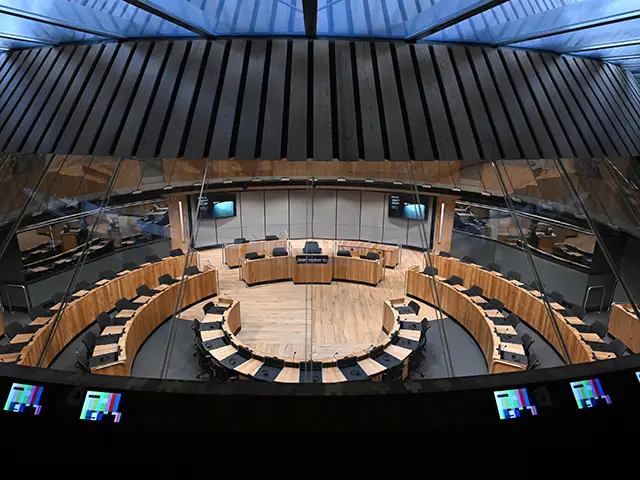
On May 7, the way we vote in Senedd elections is changing.
If recent opinion polls are to be believed, the election could be one of the most consequential since the Welsh Parliament – then known as the Welsh Assembly – was established in 1999.
But from new constituencies and more elected members, to changes in how votes are counted, there’s a lot to get your head around.
What’s changing?
There are three key changes in the upcoming election: the number of Senedd Members elected, changes to constituencies, and a new electoral system.
Until now, the Welsh Parliament – or Senedd Cymru – has been made up of 60 politicians: 40 constituency Members of the Senedd (MSs) and 20 regional MSs.
Historically, constituency boundaries largely mirrored those used for UK Parliament elections. The 20 regional members were elected across five areas of Wales, with each region returning four MSs.
The constituencies representing Caerphilly County Borough all formed part of the South Wales East region.
The system used was a mix of first-past-the-post for constituencies – where the candidate with the most votes wins – and proportional representation for regional members.
However, Wales now has fewer MPs at Westminster following boundary changes, reducing the number of parliamentary constituencies from 40 to 32.
These new Westminster seats have been paired together by the Democracy and Boundary Commission to create 16 larger Senedd constituencies.
For example, the UK constituencies of Newport East, and Newport West and Islwyn, have been combined into one single constituency called Casnewydd Islwyn.
Each of the 16 constituencies will elect six Senedd Members, meaning the Welsh Parliament will expand from 60 to 96 members.
A new voting system
But perhaps the biggest change is the electoral system itself.
Under the new arrangements, all Senedd Members will be elected using a form of proportional representation calculated using the d’Hondt formula – the same method previously used to allocate regional seats.
Devised in 1878 by Belgian mathematician Victor D’Hondt, the formula allocates seats in a way designed to reflect the share of votes each party receives.
Political parties submit lists of candidates in each constituency, ranked in order. As seats are allocated, candidates are elected from the top of each party’s list.
The more votes a party receives, the more seats it is likely to win.
The system works by dividing a party’s total number of votes by the number of seats it has already won, plus one.
So, after winning a seat, a party’s vote total is divided by two. After winning two seats, it is divided by three and so on.
Seats are allocated in rounds, with the party with the highest total in each round winning the next seat.
This process continues until all six Senedd Members for the constituency have been elected.
For example, if Plaid Cymru received the most votes in Blaenau Gwent Caerffili Rhymni, it would win the first seat and the first candidate on its list would be elected. The party’s vote total would then be halved, and the next seat would go to whichever party then has the highest total.
Why has it changed?
The idea is that under the new system the number of seats won by each party reflects the share of votes they receive, creating what should be a more representative parliament for Wales.
Under this system, it is highly unlikely that any one party would be able to win all six seats in a constituency.
The method is designed to give greater representation to parties who wouldn’t otherwise be elected through the first-past-the-post system.
The changes to the voting system come as part of wider reforms to the Senedd agreed by the Labour Welsh Government and Plaid Cymru in their 2021 co-operation agreement.
How does this affect your vote?
As Senedd seats will be allocated based on each party’s vote share, the new system means your vote is more likely to help decide the overall result.
Importantly, your voting paper (ballot) will also change with voters having one vote instead of two.
Previously, voters had two votes. The first to choose the candidate they hoped would be elected as the local MS and the second to back a political party.
The second vote was then used to allocate the four regional seats in each area using the D’Hondt formula.
From the 2026 election onwards, voters will instead cast a single vote for a political party rather than an individual candidate.
If that party receives enough votes, it will win one or more seats and candidates will be elected from its list.
It is also important to remember that unlike UK Parliament general elections, voters do not need to show ID at voting stations.
Laura McAllister, professor of public policy and the governance of Wales at the Welsh Governance Centre at Cardiff University, previously chaired an expert panel set up to examine how the Senedd should evolve.
The Expert Panel on Assembly Electoral Reform, established by the Senedd Commission in 2017, was tasked with looking at the size of the Welsh Parliament, the voting system used to elect its members and whether the voting age should be lowered.
Its report, A Parliament that Works for Wales, recommended increasing the size of the Senedd from 60 members to between 80 and 90 and replacing the existing voting system with a more proportional model.
While not all of the panel’s recommendations were adopted at the time, its work helped shape the wider debate on Senedd reform that has ultimately led to the changes being introduced for the 2026 election.
Professor McAllister said the debate over the size and structure of the Senedd had been ongoing since the start of devolution.
She explained: “The 2017 expert panel gave real form and evidence and data around the necessity to change.
“Once the legislation had gone through – the Senedd Cymru (Members and Elections) Act – it became clear there was support for a larger Senedd of 96 MSs and that changes to constituencies and the electoral system would be needed to make that possible.
“The closed list proportional representation system came in rather than the ones we recommended in our expert panel, which were first STV [Single Transferable Vote] and secondly open list PR.
“I’m very much opposed to closed list PR for a whole host of reasons, but the reason it came about was a political compromise.
“The co-operation agreement between Plaid and Labour, in the middle of this last Senedd term, gave the numbers that were needed to get this legislation over the line and the deal was that Plaid would support a changed electoral system that they didn’t approve of in return for support for expansion of the Senedd.”
Professor McAllister said the D’Hondt system used to allocate seats could make some results difficult to predict, although overall it favours the largest parties.
While there is no formal vote threshold, the size of the new six-member constituencies means parties will likely need around 12% to 13% vote share to win a seat.
Parties polling below that level are unlikely to gain representation, although smaller parties – and individual candidates – could still win a seat if they perform strongly.
“The fifth and sixth seats in each of those constituencies will be determined by a very, very, small number of votes, certainly under 1,000, maybe a couple of hundred,” explained Prof McAllister.
“So that’s why we can’t anticipate the allocation of seats regardless of what the polls tell us, because the threshold is quite broad in terms of the bracket of seats that a number of votes could generate.”
Support quality, independent local news Help fund public-interest journalism in Caerphilly County Borough from just £1 a month and enjoy an advert-free website experience. Become a member today →