
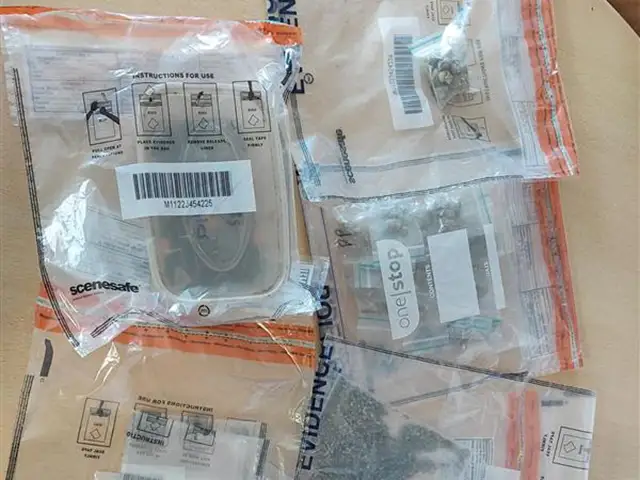
Lost, damaged, or ‘missing’ evidence was to blame for the collapse of 145 prosecutions at Gwent Police over the past two years, according to research by the BBC’s Shared Data Unit.
A total of 8,861 prosecutions were handed to the Crown Prosecution Service (CPS) between October 2022 and September 2024 by Gwent Police, meaning 1.6% didn’t proceed. One of the 145 collapsed cases was a sexual offence.
The CPS figures, obtained by the BBC under the Freedom of Information Act, includes evidence that is lost, missing, damaged, or unavailable. When this is the fault of the police force, it is categorised as “E72”.
It includes instances where police may not be able to find an expert witness or get a medical statement for example.
An E72 can comprise of a number of scenarios, such as:
- Physical evidence – including forensic evidence – being lost, damaged or contaminated during the storage phase.
- Digital evidence, such as victim interview footage or body camera footage, being lost during the storage phase.
- Witness statements or pathology reports not being made available by police.
- Key evidence not gathered from the crime scene.
Gwent Police Assistant Chief Constable Nicholas McLain said: “We work closely with the CPS to present them with the highest quality of evidence to secure justice for victims of crime in Gwent.
“This data refers to cases where key evidence is not available or missing and there are a variety of reasons why this might happen, meaning that some defendants could not be prosecuted.
“While these occasions are rare in Gwent, we still understand the impact that this may have on victims and recognise how disappointing it must be for their cases not to proceed.
“As a victim-focussed service, our officers are committed to conducting investigations in the most professional and thorough manner possible aiming to secure justice for all our victims.”
National issue
Across England and Wales, more than 30,000 criminal cases failed because of the same issue including 70 murders and 554 sexual offences.
Experts told the BBC’s Shared Data Unit the increasing proportion of cases collapsing due to missing evidence was due to:
- The closure of the Forensic Science Service in 2012
- A lack of scrutiny over evidence retention
- The growth in digital evidence and increasing demands on storage space
- Fears over police budgets and resources
- A wave of inexperienced police recruits were leading to more items being lost or mishandled at local forces.
“A resourcing issue”
Professor Carole McCartney, a criminology lecturer at the University of Leicester, is an expert on evidence retention.
She said that, although funding for police forces has increased in recent years, many were still reporting large budget deficits.
“All this is a resourcing issue,” she said.
“Just look at gun stores – you wouldn’t believe the amount of guns the police are storing, never mind all the other weapons.
“I’ve been in warehouses full of motorbikes, scaffolding poles, and things that are seized and have to be retained. I’ve seen a four-poster bed in a storage place.
“It’s just mind-boggling what the police have to store. This all takes a lot of organisation, a lot of money, a lot of resourcing and an awful lot of technology to keep track of all of this.
“But it doesn’t attract any particular attention or resourcing.”
Storage problems
The Forensic Science Service (FSS) previously stored forensic exhibits on behalf of the police forces and government agencies of England and Wales, as well as other services.
But its closure in 2012 prompted criticism.
It meant much of the work previously carried out by the government-owned company was transferred to police forces themselves, who would either catalogue and keep evidence on police premises or contract private providers.
“The government did not consider enough evidence in its decision-making,” the Science and Technology Committee wrote in a 2011 Parliamentary report.
“The wider impacts to the criminal justice system appear to have been hastily overlooked in favour of the financial bottom line,” it added.
At the time the FSS was making losses of about £2m a month.
The National Forensics Archive in Birmingham now holds all national pre-2012 exhibits and over the last two years and was crucial in overturning the conviction of Andrew Malkinson, who spent 17 years in jail for a wrongful rape conviction – in 2023.
Police forces, which are required to keep evidence indefinitely in the most serious cold cases, now have separate arrangements for storing and accessing all kinds of evidence.
However, there is no specific performance metric, which judges how well police store and maintain evidence.
“We have lots of concerns, lots of reports around police forces,” said Prof McCartney. “Do they attend crime scenes? What do they do when they’re at a crime scene? How quick do they respond to crimes?
“These get a lot of attention and there are a lot of targets to meet in these areas.
“But then we don’t have sufficient attention paid to what happens after this. How do crimes then get investigated? Has the evidence been labelled properly? Has it been put onto a computer system? Are we storing it properly and can we retrieve it when we need to examine it?
“If those basics are not being done – and I think the figures show that increasingly they’re not – this means it doesn’t matter how quick we got to a crime scene.”
The Law Commission’s consultation on Criminal Appeals recently proposed that responsibility for long-term storage of forensic evidence should be transferred to a national Forensic Archive Service – effectively re-establishing the pre-2012 procedures.
It also proposes the “unauthorised destruction, disposal or concealment of retained evidence” be made a specific criminal offence.
A spokesperson for the National Police Chiefs’ Council said: “Police and the CPS work together to ensure evidence is gathered and presented in a timely manner, bringing offenders to justice and ensuring victims are safeguarded.
“The E72 category refers to evidence that is either missing or unavailable when a defendant is going to trial following being charged.
“For example, police may not be able to find an expert witness to give evidence or it may be that a required medical statement cannot be obtained.
“When evidential issues occur in a case, the CPS will raise this with police for any action deemed necessary and we will work together to ensure these are resolved wherever possible.”
| Police force | Total prosecutions handed to the CPS between October 2022 and September 2024 | Number of cases collapsing due to lost or missing evidence (E72) | Proportion of cases collapsing due to lost or missing evidence (E72) |
| Metropolitan Police | 106524 | 4887 | 4.6% |
| City of London Police | 3156 | 102 | 3.2% |
| Leicestershire | 14551 | 384 | 2.6% |
| Staffordshire | 14467 | 358 | 2.5% |
| Lincolnshire | 11735 | 286 | 2.4% |
| Derbyshire | 16717 | 367 | 2.2% |
| Hampshire | 21343 | 465 | 2.2% |
| West Midlands | 27553 | 582 | 2.1% |
| Northumbria | 19884 | 406 | 2.0% |
| Essex | 21135 | 416 | 2.0% |
| Wiltshire | 8875 | 168 | 1.9% |
| Kent | 22003 | 396 | 1.8% |
| Cambridgeshire | 9718 | 170 | 1.7% |
| Bedfordshire | 7132 | 124 | 1.7% |
| Warwickshire | 5283 | 91 | 1.7% |
| Hertfordshire | 11731 | 196 | 1.7% |
| Gwent | 8861 | 145 | 1.6% |
| Northamptonshire | 11746 | 190 | 1.6% |
| Humberside | 14494 | 232 | 1.6% |
Support quality, independent local news Help fund public-interest journalism in Caerphilly County Borough from just £1 a month and enjoy an advert-free website experience. Become a member today →